



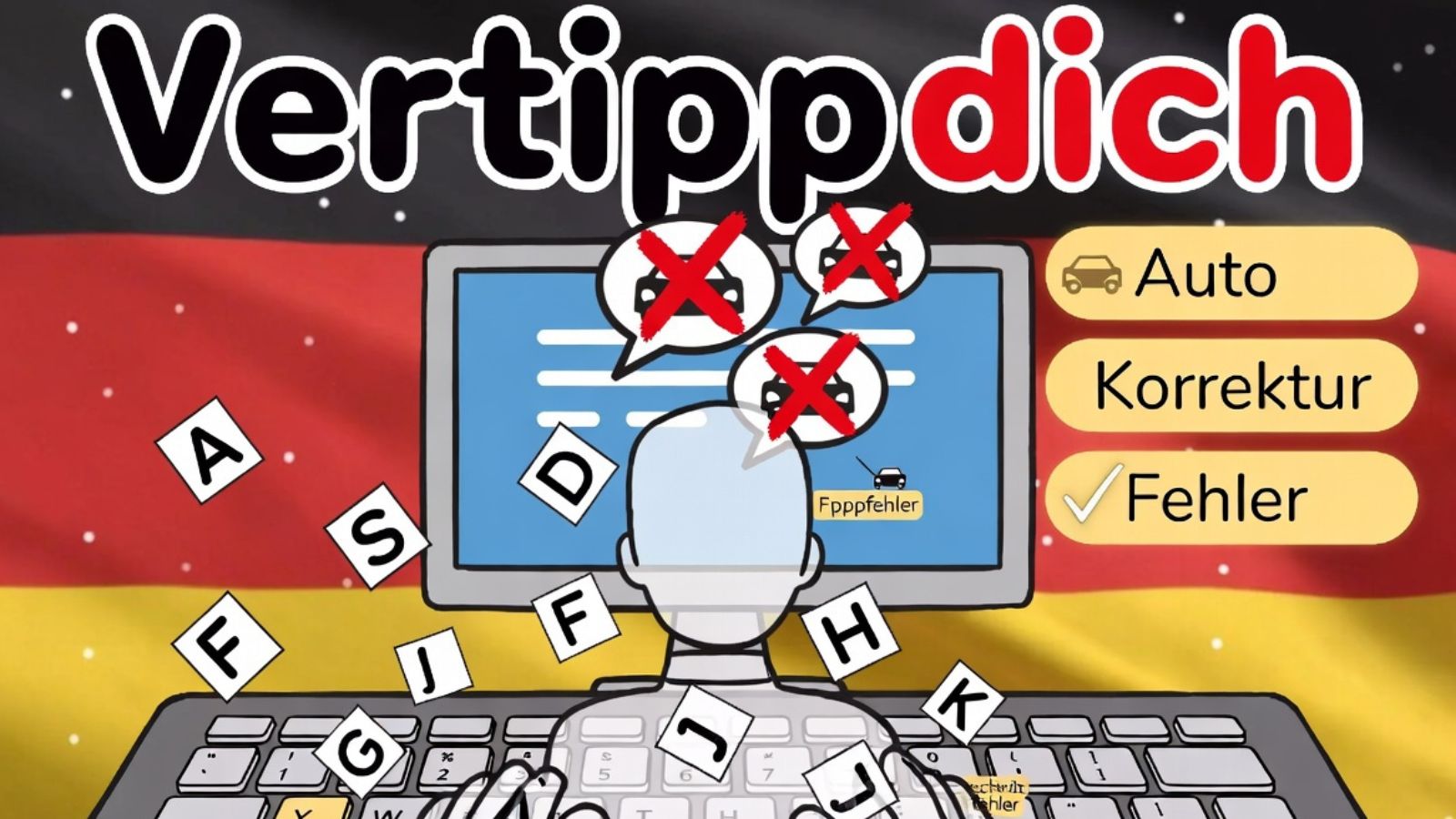
People’s communication has changed as a result of the digital age, which has brought convenience as well as new difficulties, including frequent typing errors. Particularly in German-speaking societies, where linguistic accuracy is culturally significant, a ‘Vertippdich’ stands out as a humorous approach to recognise these errors. This article explores the idea in great detail, tracing its language origins, looking at technological and psychological aspects, and providing useful minimisation techniques. Readers can improve their writing practices and promote more understanding in cross-cultural interactions by learning about the entire range of German typos and more general digital errors.
- Vertippdich Linguistic Origins
- Typical Reasons for a Vertigo Attack
- The Psychological Aspects of Typos
- Technological Aspects Affecting Digital Mistakes
- Typical German Typos and ‘Vertippdich’ Moments Examples
- Vertippdich’s Effect on Relationships and Communication
- Techniques to Reduce Typing Errors in Everyday Life
- Typos’ Development in the Digital Age
- In conclusion
- FAQs
Terms like ‘Vertippdich’ demonstrate how language is always changing. Understanding these components enhances your understanding of the subtleties of contemporary conversation, regardless of whether you are a native speaker, a learner, or someone interested in internet slang. The topic is thoroughly examined in the sections that follow, making it appropriate for anybody interested in linguistics, technology, or common communication mistakes.
Vertippdich Linguistic Origins
The reflexive German verb “sich vertippen”, which literally means “mistyping oneself”, is the source of the phrase Vertippdich. The prefix “ver-“, which denotes a departure or error, is combined with “tippen”, which means to type or tap, and the colloquial “dich”, which addresses “you”. When someone discovers a mistake in a message, it is typically used as a light-hearted or kind correction.
German orthography places more emphasis on phonetic consistency than English; however, precise spelling is sometimes overshadowed by quick digital input. Druckfehler, or printing errors, were brought about by historical effects from the printing press era and are comparable to modern keyboard slips. The idea was easily incorporated into internet society, where speed often takes precedence over correctness, as typewriters gave way to computers.
Typical Reasons for a Vertigo Attack
A ‘vertippdich’ can happen during typing sessions for a number of reasons. Keyboard layouts are important, particularly the German QWERTZ arrangement, which frequently causes confusion for bilingual users because it switches Y and Z in contrast to the English QWERTY. Although useful, autocorrect features may make mistakes of their own by recommending incorrect replacements based on context or prior inputs.
These problems are made worse by fatigue, multitasking, and using small mobile devices. Attention to detail is diminished by psychological factors such as cognitive stress during rushed interactions. These minor mistakes can sometimes change intended meanings in social or professional contexts, highlighting the need for attentiveness.
The Psychological Aspects of Typos
Typing adds layers of motor skill demands that might falter under duress, and human cognition processes language output in sophisticated ways. A Vertippdich frequently results from the brain giving meaning precedence over mechanical execution, particularly in casual conversations where t’vertippdich’ is on rapidly communicating ideas. Frequent typists acquire muscle memory, but pauses or diversions break this flow, according to psycholinguistic research.
Error rates are also influenced by emotional emotions. Slips are more likely when one is excited during stimulating conversations or stressed out during crucial communications. Knowing these mental foundations enables people to implement attentive behaviours that lessen incidents without compromising the spontaneity of conversations.
Technological Aspects Affecting Digital Mistakes
Even though modern devices use complex algorithms to predict and correct content, they may make issues worse rather than better. Smartphone predictive text recognises user patterns, but it has trouble with proper nouns, slang, and multilingual input that is typical in German contexts. Users may be caught off guard by unexpected changes in autocorrect behaviours caused by software updates.
Another dimension is introduced by voice-to-text choices and accessibility tools, where variations in pronunciation result in outputs that are misconstrued. Future advancements in artificial intelligence promise more intelligent error detection as it becomes more deeply integrated into communication systems, while present constraints emphasise the continuous dance between human intent and machine aid.
Typical German Typos and ‘Vertippdich’ Moments Examples
Typing errors in everyday German talks show Vertippdich in action through recurrent patterns. Words that contain umlauts, such as “-, Mün,,” often appear without diacritical marks or are substituted improperly. For example, “Mün”,ecomes “Mutter”—wait, no—or “schon” is typed as “schonn” or “dass” is mistaken for “das.” In a hurry, people tumble over common homophones or near-homophones.
Innovative versions are displayed on social media and messaging apps, where participants jokingly call out a ‘Vertippdich’ with follow”das”.its or emoticons. Through common linguistic errors that go beyond rigorous grammatical rules, these incidents not only amuse but also strengthen ties throughout the society.
Vertippdich’s Effect on Relationships and Communication
A little verbal diarrhoea rarely results in long-term damage in interpersonal relationships and frequently provokes laughter that deepens bonds. However, unchecked mistakes could give the impression of carelessness or result in misunderstandings with serious repercussions in professional settings or delicate conversations. Clarity is highly valued in German-speaking cultures, therefore attentiveness is especially important.
These behaviours are normalised by broader cultural movements toward shortened online language, but they also pose challenges to conventional ideas of literacy. Effective digital etiquette across generations and geographical boundaries still requires striking a balanc; therefore,nformality and precision.
Techniques to Reduce Typing Errors in Everyday Life
The frequency of a vertippdich is greatly reduced by practical practices. Maintaining correctness can be achieved by slowing down during significant compositions, checking before sending, and personalising autocorrect dictionaries. For long texts, using extra keyboards or larger screens lessens physical strain.
Over time, improved proficiency is developed by practice and education, such as typing lessons customised for German layouts. Without lessening the enjoyment of brief conversations, mindfulness practices that promote concentrated attention while messaging further enhance better results.
Typos’ Development in the Digital Age
The type of typing errors have changed in tandem with technology, from early internet forums to modern social platforms. Today’s verbiage could include overuse of emojis or predictive text errors that were unthinkable decades before. Cross-linguistic impacts brought about by globalisation enhance slang while confusing mistake patterns.
Future developments, such as sophisticated AI assistants and smooth voice interfaces, might reduce conventional typos but bring in new difficulties like mispronounced orders or algorithmic biases. Keeping up with these changes helps users remain adaptable in a constantly evolving communication environment.
In conclusion
Examining the idea of a ‘Vertippdich’ reveals a lot about digital human interaction. Even though they can be annoying at times, these minor mistakes humanise our talks and offer chances for understanding and humour. People can develop more patience with themselves and others by accepting the reality of typing in a fast-paced society. This will ultimately improve the quality of their conversations. The dynamic aspect of language itself is highlighted by the fusion of linguistic legacy with technological advancement. (Roughly five or six lines)
As society develops, better practices in both the personal and professional domains are made possible by understanding the causes and solutions of digital errors like Vertippdich. In a linked global community where small errors are part of the rich tapestry of everyday expression, ongoing study of linguistic nuances promotes empathy and efficacy. Potential hazards are transformed into educational moments by awareness, which celebrates imperfection as a common human experience. (Roughly five or six lines)
FAQs
What does the term “vertippdich” mean in German conversations?
It might refer to a typing error or the fun act of pointing it out. In conversations, it promotes light-hearted recognition as opposed to criticism.
What role does the German keyboard play in additional instances of “Vertippdich”?
In contrast to normal English configurations, the QWERTZ layout switches keys like Y and Z, making it more difficult for users to move between languages and increasing the chance of a slip when typing quickly.
Does autocorrect make a verbose issue better or worse?
Although autocorrect frequently avoids mistakes, it occasionally causes new ones by misinterpreting intent, particularly when using unusual words or in multilingual situations that are typical among German speakers.
Are there cultural variations in how different languages handle typos?
In contrast to more accepting attitudes in some other language communities, German culture tends to emphasise accuracy, yet online forums welcome amusing “Vertippdich” corrections.
What are some useful tools for lowering digital typing errors?
Over time, grammar checks, personalised dictionaries, speech-to-text applications, and consistent typing practice all help reduce errors.
Are only native German speakers using Vertippdich?
Although the phrase and idea originated in German, they expanded to multilingual online communities, where users embraced it for its succinct, entertaining method of pointing out mistakes.
What impact has social media had on the prevalence and perception of typos?
Platforms encourage speed, which results in more ‘vertippdich’ moments, yet communities tend to see them favourably as relatable human characteristics rather than defects.
Which next technology has the potential to erase the majority of typing errors?
Significant reductions are promised via improved voice recognition, brain-computer interfacing, and advanced AI prediction, while new mistake kinds might appear.